Japanese or English One Piece Cards, the Thailand Buyer's Guide
Both are printed by Bandai, so the choice is not about quality. It is about timing, local supply, card backs and resale. A clear decision guide for One Piece collectors and players in Thailand.
Kira Cards 편집팀
Kira Cards Co., Ltd.(파통, 푸껫)를 이끄는 팀이 작성했습니다. 2026년부터 전업 TCG 리테일러이자 컬렉터입니다. 팀 소개
One key difference, same publisher
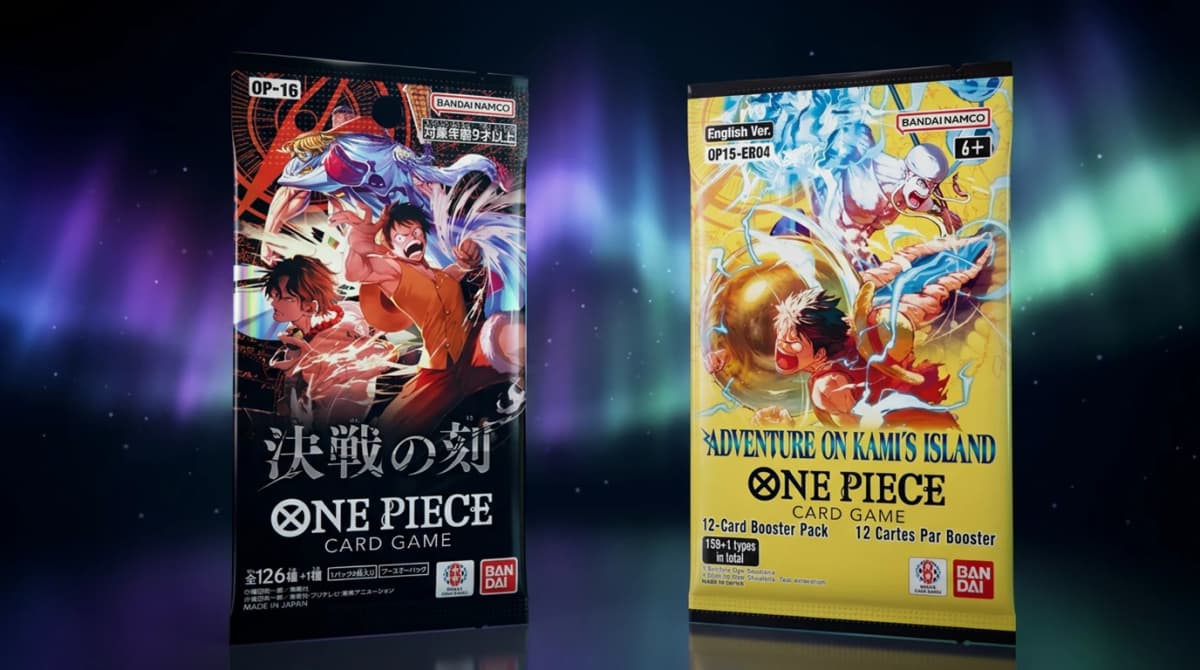
This is the fact that changes everything, and it is the opposite of Pokemon. With Pokemon, Japanese is made by The Pokemon Company while English is handled by a separate licensee, which is why the two prints diverge on quality and treatments. One Piece is different. Both the Japanese and English One Piece Card Game are published by Bandai.
Because it is the same company, the rarity system, the card frames, and the foil treatments line up almost exactly between the two languages. There is no inherent quality gap the way collectors argue about with Pokemon. The real differences are timing, availability, card backs and the secondary market, not whether one print is fundamentally nicer than the other.
Release timing and set codes
Japanese sets release first. English equivalents follow on a delay that has typically run somewhere between six months and a year, and Bandai sometimes reorders or rebundles content for the English schedule.
The codes are worth learning because they appear on every product. OP marks a main booster set (OP-01 through the current numbering), EB marks an Extra Booster, ST marks a Starter Deck, and PRB marks a Premium Booster. Japanese and English share this code system, but the same code can land months apart in each language. When you compare prices, always match the exact set and language, not just the character on the card.
Print quality and grading
Because both are Bandai, print quality sits much closer than it does for Pokemon Japanese versus English. That said, several early English sets shipped with noticeable quality-control complaints, edge whitening, off-centering and surface marks were common talking points at English launch, while Japanese print runs held a steadier baseline.
For grading, the cards that justify a slab are the same in both languages, Secret Rares, alternate-art parallels and Manga Rares. Japanese copies tend to be the default choice for grading in Asia simply because supply is deeper and the market is more liquid here. If you are submitting to PSA or a regional grader, condition out of the pack matters more than language, so handle and store carefully either way.
Rarity tiers and the cards that hold value
One Piece uses a clear ladder, Common, Uncommon, Rare, Super Rare, Secret Rare and Leader, with Parallel alternate-art versions and Manga Rares sitting on top as the true chase cards. Leaders anchor decks, but the cards collectors pay up for are alt-art parallels of popular characters and the manga-style rares.
Here is the part new collectors miss. Bandai reprints heavily in both languages to meet demand. That keeps the game accessible, but it also caps how much sealed product appreciates over time compared to scarcer Pokemon Japanese sets. In One Piece, value concentrates in specific chase singles far more than in sealed boxes. If you want a particular Luffy, Zoro, Nami or Uta alt-art, buying the single is usually smarter than ripping boxes hoping to hit it.
Card backs and tournament play in Thailand
Japanese and English cards have different card backs. In sleeved tournament play that means a deck must be a single language, you cannot legally mix a Japanese card into an English deck or vice versa, because the backs would be distinguishable.
In Thailand and across most of Asia, the Japanese version is the dominant competitive and local format, and Japanese product is what most events and player groups are built around. English has its own organized play, but locally it is the minority. If you intend to play in Thai events, Japanese is the safer commitment. Always confirm the language requirement of the specific event before you build, because that single rule decides which cards you can bring.
Pricing and availability in Thailand
Japanese One Piece is simply easier to buy in Thailand. It arrives first, it stocks deeper, and it resells faster because the local player base runs on it. English product is thinner on local shelves and frequently carries an import premium, so a like-for-like set can cost more in English here even though both come from Bandai.
Compare at the box level for an honest picture. Per-pack pricing can mislead, and the more useful question for a Thai buyer is which language you can actually restock and resell without hunting. For most people here, that answer is Japanese.
Which should you collect?
Choose Japanese if you play or plan to play in Thailand, you want the deepest local supply, or you care about resale liquidity in the local market. For the large majority of collectors and players here, Japanese is the default.
Choose English if you specifically prefer reading cards in English, you are part of an English-language playgroup, or you are building around a character whose English alt-art you simply like more. There is no quality penalty for that choice, it is a preference, not a downgrade.
As with any TCG, the cleanest collections commit to one language for the main binder and treat the other as occasional pickups tied to a specific card. With One Piece, the card-back rule makes that discipline matter even more if you ever want to play.
| Dimension | Japanese | English |
|---|---|---|
| Publisher | Bandai | Bandai (same company) |
| Release timing | First | Follows by roughly 6 to 12 months |
| Supply in Thailand | Deep, arrives first | Thinner, often import-priced |
| Card back | Japanese back | English back (not mixable in one deck) |
| Print quality | Steady baseline | Close, but early sets drew QC complaints |
| Sealed appreciation | Capped by frequent reprints | Capped by frequent reprints |
| Local tournament use | Dominant format | Minority format |
자주 묻는 질문
Is English One Piece made by the same company as Japanese?
Yes. Both the Japanese and English One Piece Card Game are published by Bandai. This is the opposite of Pokemon, where English is handled by a separate licensee. It means rarity treatments and frames match closely, so the gap is about timing and availability, not quality.
Can I mix Japanese and English One Piece cards in one deck?
No. The two languages have different card backs, so a tournament-legal deck must be a single language. You choose one and build the whole deck in it.
Which is more available in Thailand, Japanese or English?
Japanese, by a wide margin. It releases first, stocks deeper, and resells faster because the local scene runs on it. English is thinner locally and often carries an import premium.
Do One Piece cards hold value well as sealed product?
Less than scarcer Pokemon Japanese sets, because Bandai reprints heavily in both languages. Value concentrates in chase singles, alt-art parallels and Manga Rares rather than sealed boxes.
Which should a new player in Thailand buy?
Japanese, in most cases. It matches the dominant local format and supply, so it is easier to play, restock and resell. Choose English only if you specifically need English text or play in an English-language group.